
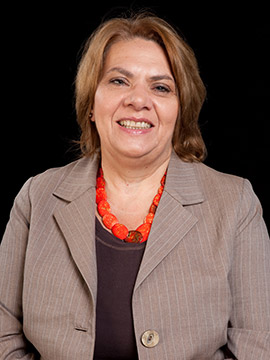
Ma. del Carmen Rico is an Associate Professor at the Université du Québec à Montréal, Canada, and was born in Uruguay. Her work lies at the intersection of communication, health, and development, with a particular focus on intercultural contexts. Throughout her career, she has been involved in high-level international academic networks, holding various leadership positions, including UNESCO Chair in Communication and Vice President of ORBICOM, the Global Network of UNESCO Chairs in Communication.
Her research connects the North from the perspective of the Global South through an interdisciplinary approach to communication, addressing issues such as inclusion, social justice, and structural inequalities. Carmen will deliver the opening keynote lecture at ICOMTA 2026.
ICOMTA 2026 – You have worked for decades in international and intercultural communication. What current technological challenges do you consider most urgent for rethinking contemporary communication?
Among others:
- The fully enveloping and immersive nature of technology;
- The supposed blurring of boundaries, decentering, and deterritorialization;
- The nomadic mode of consuming information while constantly on the move, which recalls Marc Augé’s concept of the “non-place”;
- The risk of seduction and of becoming trapped in the fallacy of the reification of technology, rendering human processes invisible;
- The persistence of divides that technology does not resolve in and of itself.
ICOMTA 2026 – Throughout your career, you have defended critical approaches to development. What does “development” mean today from a Global South communicational perspective?
First of all, it means studying it from “here,” from the South, through a process of conceptual decolonization. Although today we speak of communication for sustainable social change, this formulation also raises concerns for me because of the instrumentalization of the very concept of communication.
Today, “development from the South” implies recognizing local knowledge systems that generate initiatives, engage in dialogue, diagnose, plan, and produce in cooperation, without dependency-based approaches or external technical impositions.
ICOMTA 2026 – As the opening keynote speaker at ICOMTA 2026, could you share some of the key ideas of your lecture?
We will raise a series of critical questions, avoiding Manichean positions regarding generative AI:
How should we position ourselves in the face of technological overabundance, for some;
- the exponential production of information, for many; and the dizzying speed at which technological possibilities for the reproduction of language are developing?
- What is the relationship between generative AI, epistemology, power, and ethics?
- Does generative artificial intelligence produce a semantic ablation that results in cognitive ablation?
- Will it lead us to a quantum leap, enabling the creation and broadening of horizons?
- These are some of the theoretical threads that we will seek to bring into dialogue with everyday technological praxis.
ICOMTA 2026 – Finally, as an expert who has studied the evolution of communication throughout your long and distinguished career, what transformations do you think will shape the future of communication over the next ten years?
My inability to predict, in light of:
- The constant emergence of new questions, the continuous future of technological communication, and Lucien Sfez’s homo communicans;
- The expansion of the field of communication: to which disciplinary fields does AI belong?
- The growing awareness of the absence of all-encompassing narratives;
- Fully immersive, sensory communication, hallucinated by the reality of the unreal;
- The convergence between artificial intelligence and quantum computing.

