
- In an interview with the ICOMTA team, she underlines the power of technology to advance fields such as healthcare but also highlights certain “downsides” like the depression and anxiety caused by excessive use of social media, especially among young people
- She is also concerned that disinformation is already influencing the 2024 U.S. presidential election, and warns that researchers are «unable to legally capture» the emergence of distorted contents
- The expert of Emory University (Atlanta, USA), will be the keynote closing speaker of ICOMTA’24 in Lima (Perú)
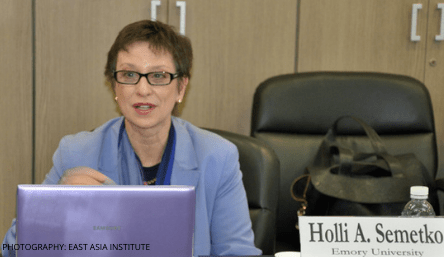
Holli A. Semetko is one of the key authors in political communication worldwide. She recently gave an interview to the ICOMTA’24 team, as she will be the keynote closing speaker at the event on September 6th. In her opinion, the main theme of the event—the relationship between communication and applied technologies—presents “many upsides in various sectors such as healthcare, transportation, and the outer space business, just to name a few.” Overall, she believes technology is transforming the way we live. However, this expert, who has extensive experience with over 100 publications in international contexts including the US, UK, Germany, Turkey, the European Union (EU), India, China, and South Korea, among others, also highlights “the downsides,” such as emerging mental health problems in certain groups.
ICOMTA’24 team – Thank you, Holli, for this brief interview. We really hope to attend your conference in Lima, which is going to be one of the big surprises of the event. Could you please share some ideas before your conference at ICOMTA’24?
Holli Semetko – On ideas I’d like to share, much has been published on the relationship between social media use and mental health. It’s not all negative news as support groups do exist on social media platforms like Facebook, which promote improved mental health. Yet much of the research that has been published points to the potential for negative impacts on adolescents and young adults, in the form of depression and anxiety for example. As we are living in stressful and uncertain times, it is important for policy makers to assess the impacts and consider how information on platforms can be improved so that users are protected.
ICOMTA’24 team – A few years ago, you proposed the so-called “fourth era of political communication” determined by big data, media consumption via social media, and the decrease in fact-checking and gatekeeping roles. With the strong presence of disinformation and computational propaganda (such as social bots, trolls organized by cyber troops mentioned by Samantha Bradshaw and others), do you believe we are heading towards a fifth era of political communication?
Holli Semetko – We are living in an era of exponential change in terms of the potential of technology to transform our lives. While there are many upsides in various sectors such as in healthcare, transportation, the outer space business, just to name a few, there are also downsides. With respect to political communication, the label ‘fourth era’ may still apply as I would say it encompasses the rapid advances in ICTs that are impacting our lives, our societies, and political campaigning today.
ICOMTA’24 team – In the book “The Formation of Campaign Agendas,” you explore the relationships between media and politicians. To what extent is the well-known Agenda-Setting theory still relevant in a context with a strong fixation and characterization of agendas through social media?
Holli Semetko – Since Twitter, renamed X by its outspoken owner, nowadays refuses to make available data that was so often used to study this influence process online, we as researchers are at an even greater disadvantage when it comes to observing agenda-setting and agenda-building online. As the volume of ‘news’ sources, both legitimate and untrustworthy, continues to expand, it is far more difficult to study the agenda setting process outside of the lab that Iyengar Peters and Kinder (1982) used to demonstrate agenda-setting and priming effects.
ICOMTA’24 team – How do you think that disinformation and computational propaganda will influence the upcoming presidential elections in the United States on November 5th?
Holli Semetko – I think disinformation already has influenced the 2024 U.S. presidential election given the evidence from 2016 on disinformation on social media platforms driven by Russia’s Internet Research Agency. Some people have recovered from the hive of conspiracy theories known as QAnon, but unfortunately, we have political elites from one large political party in Congress who stand to gain from pushing such disinformation and there were more QAnon conversions during COVID-19. The same large political party in Congress has benefitted from Russian sources of funding to the National Rifle Association, and direct donations to elites’ campaigns including the current Speaker of the House who, perhaps in turn, made every effort to let Ukrainian civilians die by failing to extend U.S. military aid from mid-2023 until recently.
ICOMTA’24 team – But what tactics are used to influence voting intentions?
Holli Semetko – When Donald Trump was in the White House, he often used terms that were found on QAnon sites, eg «the storm is coming,» potentially reinforcing the misguided beliefs of his followers in such sources. We also should not forget the person-to-person networks on the far right, especially those armed with big data, and money, to influence voters. Read the powerful book by investigative journalist Ann Nelson. 2019. The Shadow Network: Media, Money, and the Secret Hub of the Radical Right, Bloomsbury. The fact is that researchers are unable to legally capture the full range of misinformation out there with the growth in the number and size of platforms and the speed of information flow. Moreover, Kremlin talking points regularly come from the mouths of some vocal Republican members of the U.S. Congress nowadays. Apart from far-right digital news sites, on television Fox News hosts themselves are often about influencing rather than informing the public.
ICOMTA’24 team – Thank you very much, Holli! We really appreciate your kindness and vast knowledge, and we expect to continue these discussions in Lima in just a few weeks.
For more information about ICOMTA’24 and the last days of the Call for Papers currently open: https://icomta.net/
 ICOMTA'26